Thursday, August 11, 2022

Van Morrison What's It Gonna Take? 2022

So let's say you come over to my place and sit in the good seat and I play you some of the new Van Morrison record. And after five songs you think, well, this isn't too bad. Maybe not his best work, but OK for an old guy making his 43rd studio album. Absolutely Positively The Most isn't bad, a quasi-spiritual tune that sneaks in a single reference to lock down. I Ain't No Celebrity and Stage Name are both just OK, but Fear And Loathing In Las Vegas and Pretending are actually pretty good ones from Van The Man. But those are the last five tracks, and the ten before those are all Van ranting about lock down, the government is lying (and the media, too), etc. etc. blah blah blah. Even if you agree with his politics, it's a difficult listen at best. I mean, in the past when Van would go on about the music business treating him so badly (his net worth is only 90 million), it got old, but it was only one song per record.

The good news is that the music is at least as good as Van's recent better work. Roll With The Punches, The Prophet Speaks, and Three Chords And The Truth were all pretty good, and musically similar to this, and Van is singing fine. But the lyrical content is just him ranting like the anti-vax, paranoid, I have to get out and play millionaire whiner that he has become. I enjoyed Van Morrison's work throughout his career, and stuck with him even through the lesser records. But this one is even worse than Latest Record Project Volume 1. Maybe not really worse- the ratio of decent songs that aren't ranting is about the same, but that was two CDs, and this is just one CD, so there's less redemption here.

Music is OK, singing is good, and again, the best way to enjoy this one is by being unfamiliar with the English language so you don't realize how much garbage he's spewing. I should point out that Van Morrison has made grants to Northern Ireland musicians that lock down has hurt much more than it has hurt him, so he's not all blather, and that's admirable. But now it's time to see if he could get back to what he does well. Make music we can all enjoy, with lyrics about idyllic nature, love, and the blues, without all the ranting and raving against Robin Swann.

Friday, July 8, 2022

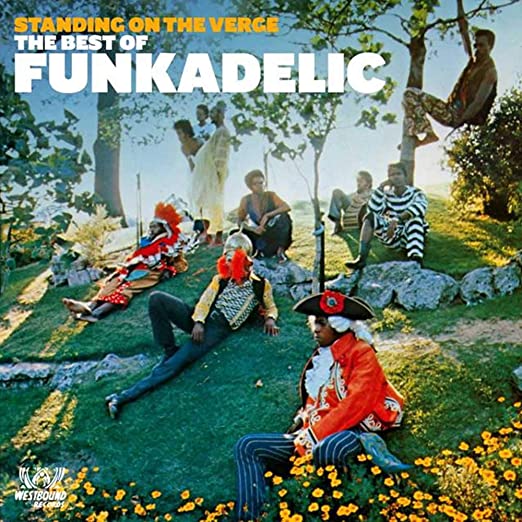
Funkadelic Standing On The Verge- The Best Of Funkadelic 2009

Funkadelic were a fascinating band, starting as early as 1969, producing psychedelic soul music that you could dance to. A few years down the road, they focused more on the dance floor, putting out funk jams that dug a deep groove and rivaled James Brown and any other funketeer on the scene. And they also featured hot Hendrix-inspired guitar from the inimitable Eddie Hazel and later Michael Hampton. George Clinton's hallucinogen-inspired philosophical ravings add an element of strange/crazy/hilarious moments.

In my view, their records were somewhat less than perfect (only a few came close). For someone that just wanted to know what their best work sounded like, a "best of" or "greatest hits" would be a fine service to the music-loving community.

But there were problems with that idea. From 1969-1976, Funkadelic made eight records for the small Westbound label, and then went to Warner Brothers for four more records between 1976-1981. And for the next twenty-eight years you could get compilations that featured only one of those two record labels output. They made more music for Westbound, but a few of their biggest hits, including their biggest, One Nation Under A Groove, were on Warner Brothers. So finally in 2009, this compilation included music released on both labels, and allowed you to take in the sum of their best work. This record features three tracks from the Warner Brothers years, One Nation Under A Groove, (Not Just) Knee Deep, and Comin' Round The Mountain. The material was licensed to Ace Records in the UK and released under the Westbound/Ace nameplate.

It isn't perfect, but it is closer than any other single compilation. Most of the longer tracks are included here in their shortened single edits, so some of the more extended jams are cut short, and this reduces the amount of great guitar playing on some songs. So you don't get fifteen minutes of Knee Deep or seven minutes of One Nation Under A Groove. But you do get the entire ten minute version of Maggot Brain, the admired and inspired Eddie Hazel guitar showcase. And you get early material from the first three records, and plenty more from their later Westbound releases.

What don't you get? You'll miss out on Who Says A Funk Band Can't Play Rock?! (from One Nation...) and there is nothing from The Electric Spanking Of War Babies 1981, a record that is considered by some as rivaling their best work. It seems like adding just one from that release would complete the set in a nice way. Every other record they released from 1969-1979 is represented by at least one track.

Is there anything else? Well, yes. This is the first release anywhere of their early self-released single Whatever Makes My Baby Feel Good from 1969, which was credited to Rose Williams and Funkadelic. So if you have to have it all, there's that, and it is a good song that shows off their talents early on.

Who needs this record? Well, I'm happy with it as it features some cuts from the first two records, and adds a few good ones from some of their less fulfilling outings. So for a good overview, it rocks. I already own One Nation Under A Groove 1978, Uncle Jam Wants You 1979, Standing On The Verge Of Getting It On 1974, and Maggot Brain 1971, but I didn't feel like I needed it all, and some of their other records have only a strong track or two. You might seek out one of the many Westbound compilations, and then add One Nation Under A Groove and Uncle Jam Wants You (both on Warner Brothers, and excellent).

If you don't own any Funkadelic and want to hear what the fuss is about, or you want a taste of what you don't already own, this is the best choice for a single compilation.

Saturday, June 11, 2022

Cassandra Wilson Another Country 2012 and Coming Forth By Day 2015

I've been catching up on some more recent Cassandra Wilson releases. Another Country 2012 features Fabrizio Sotti, an Italian guitarist. He assists Cassandra with songwriting, producing, and of course he plays guitar. Beautiful, expressive, perfect guitar. It is no surprise to hear Wilson collaborate with a guitarist as she is one herself, and her bands both live and in studio have featured guitar and percussion over piano or horns for her preferred sound.

I hadn't heard it since it wasn't just a Cassandra Wilson record, and I wasn't sure about "featuring" another artist. Let's put that to rest. This is a wonderful Cassandra Wilson record made even better with the addition of Mr. Sotti. These two are great for each other. All the things about her great Blue Note releases is here in spades, perhaps just a little sparser than usual, with a small combo of guitar, percussion, bass, and accordion. The songs are all co-writes except the opening Red Guitar by Wilson and a version of O Sole Mio that Wilson and Sotti arranged. If you like Wilson's work for Blue Note (1993-2010), you'll want to hear this.

Coming Forth By Day 2015, a tribute to Billie Holiday, should be exciting news, but instead it is an unfortunately flawed record. Song selection is fine with songs both written by and/or associated with Billie Holiday. But the overly "atmospheric" sound is just too much for my tastes, and the record never seems to leave the ground. What could cause this? Well, for starters, the record was produced by Nick Launay, producer for Nick Cave and the Bad Seeds, as well as countless pop-rock and punk records. Launay may have a fine reputation for the work he has done, but none of that work has been jazz. Additionally, he uses the bass and drummer from the Bad Seeds, and while they may be fine musicians, they aren't jazz pros, and they don't help. Bassist Martin Casey sounds especially wrong for these tunes.

On a few songs, and when there is some semblance of energy, there is moderate success. But the overuse of echo, looped guitars, ethereal, atmospheric sounds and too slow pacing makes this a better nap soundtrack than an engaging record. I should point out that several songs are made better with Van Dyke Parks' string arrangements as well as the work of The Section Quartet and their leader/arranger Eric Gorfain. At least if you're going to go languid, add some nice strings.

Wilson's singing isn't the problem, nor does it overcome the problem. The problem is too much ambiance and not enough energy. A major disappointment from a usually fine artist that has given us so many great recordings.

Thursday, May 19, 2022

Bonnie Raitt Just Like That... 2022

Bonnie Raitt is having one heck of a late career surge. At 72, she has done it again, making the kind of blues/pop/rock/folk that she has always produced, and doing it as well as ever. With her last two releases, the 2012 career highlight Slipstream, and 2016's Dig In Deep, we now have the trifecta that eludes so many artists, three great ones in a row. Given the quality of her work over the years, it should not come as any surprise, and yet it is no less an impressive string of exceptional work.

All the elements are here. Bonnie is first a singer of great depth, one of those who inhabits a lyric. If you don't choke up when she sings a sad one, there's something wrong with you. Then there is her gifted way with slide guitar. Never flashy, and always perfect for the song. She also has an ear for great songs, and always finds some classics from a wide array of writers, plus she writes several strong ones herself. And she is once again using her touring band, and they are a very talented group. Ricky Fataar drums, Hutch Hutchinson bass, Kenny Greenberg guitar (long-time guitarist George Marinelli on two tracks), and new keyboardist Glenn Patsche. It is a well-oiled machine. Recorded and mixed by Ryan Freeland, who did similarly fine work on the two before this one.

The record kicks off with the upbeat Made Up Mind, which starts things off in fine style. Al Anderson's Something's Got A Hold Of My Heart has a laid back tempo and some tasty slide from Bonnie. Livin' For The Ones is a Stones-y rocker from Marinelli and Bonnie that rocks more than most and features hot guitars. Bonnie's own Just Like That is a tender acoustic ballad that tells an intense story of love and loss. When We Say Goodnight starts slow, then picks things up, and ends with a hot guitar/keyboards jam. 

Your Jones is always just around the corner is the message of Waiting For You To Blow, a funky workout featuring Patsche on the Hammond B3 and electric piano. Slow burner Blame It On Me has one of those killer close-miked Bonnie Raitt vocals, plus more fine slide guitar and B3. Love So Strong is a Toots Hibbert reggae tune that lets the band stretch a bit. More funky electric piano and slide light up Here Comes Love, and Bonnie's pen closes the record with the sweetly moving Down The Hall, a story of a prison hospice, played on acoustic guitar and organ, with another touching vocal.

If you've liked her recent work, this won't disappoint. If you haven't heard Bonnie since 1989's Grammy-winning  Nick Of Time, you've been missing out.

Wednesday, May 4, 2022

John Hiatt Bring The Family 1987

In The Absolute Sound magazine May/June edition, they updated and published their Super LP list, an extensive listing of LPs that have better sound than most. There's a lot of classical music entries, but there is also a pretty extensive list of great pop/rock and jazz LPs as well. One of those is John Hiatt's 1987 classic Bring The Family. The record is nicely recorded and does indeed sound great, and the band (Hiatt on guitar and vocals, Nick Lowe on bass, Jim Keltner on drums and Ry Cooder on guitar) is superb.

If you haven't heard it, you must. It is another record that should be on my perfect records list, every song is just plain killer. Hiatt has made several that approach its greatness, but he hasn't bettered it.

I listened to it not too long ago, but the featured list made me pull it out and listen again. Not only is the band unusually talented, but Hiatt brings one of the finest set of masterfully written, heartfelt songs ever recorded, and he sings the daylights out of them all. His vocals are close-miked and you can feel the choke in his voice on the sad songs. But it is certainly not all sad, with Memphis In The Meantime, Thing Called Love (made famous by Bonnie Raitt), Thank You Girl, and the humorous Your Dad Did.

But those ballads are strikingly beautiful. Have A Little Faith In Me is as perfect a love song as any ever sung. Learning How To Love You is right there with it, an ode to staying with the learning curve for the payoff. Lipstick Sunset is as melancholy and sweet as a song about imperfect love can be. Tip Of My Tongue tells the story of the man that said the wrongest thing ever, and paid the highest price.

I broke your heart
With the back of my mind
From the tip of my tongue
To the end of the line
 
You couldn't say how much it hurt you
And I couldn't see the damage I'd done
'Til I watched the greatest love I've known
All come down to a slip of the tongue
 
Well I'd take it back
But time won't let me
No, time just takes
You further away
 
I watched you pack
A house full of memories
Where did you go
Lord, what did I say?
 
I broke your heart
With the back of my mind
From the tip of my tongue
To the end of the line

Monday, April 11, 2022

Songwriters

I recently had a chat or two with my brother about songwriters. First it was an article about Carole King, and then it opened up to songwriters in general. He posited that Lennon and McCartney were the best because they wrote so many great songs and no two were the same.

Not too long ago Rolling Stone did one of their lists of the 100 Greatest Songwriters, and those lists they love so much are enough to drive just about anyone crazy. I was apoplectic by the time I read through the list, but I think they do it on purpose just to yank your chain. I was reminded of many great songwriters, and just aghast at some of the choices. 

So what is the criteria to be one of the greatest songwriters. Is it how many you write? Is it consistency of quality? Is it chart position or sales? Are a few absolutely amazing songs enough to qualify? Is it the variety of songs in different styles that sets a writer apart?

I have my own biases of course, but I've always said that bands are generally better with more than one songwriter, either when two work as a team or when two writers each contribute to a band's material. Things are just more varied this way, because any one songwriter only has so many song ideas and/or styles to contribute. Of course there are exceptions.

Rolling Stone listed Bob Dylan as #1, and then McCartney as #2, and Lennon as #3. I really think they should have listed Lennon/McCartney as a team at #1 or #2, rather than list them separately. Neither of them wrote as many consistently great songs after the Beatles than they produced together. So I guess the consistency thing is big for me. I can see going with Dylan as #1, but frankly, his work for almost twenty years between 1978 and 1997 includes many weak songs.

The list reminded me of Smokey Robinson, Stevie Wonder, Marvin Gaye, and Holland/Dozier/Holland for their work at Motown and beyond. In rock/pop, the Jagger/Richards team, Bruce Springsteen, Brian Wilson, Prince, Elvis Costello, John/Taupin and Ray Davies all deserve accolades. Singer/songwriters Jackson Browne, Joni Mitchell, and Lucinda Williams wrote plenty of great ones. But some of the choices Rolling Stone made seem designed to push my buttons. Stevie Nicks, Neil Diamond, Max Martin, Bono and The Edge? Oh, please.

The Beatles made something like 13 studio records. Not too many bands or artists have made as many, and as many solid ones, as Lennon /McCartney produced. There are a few artists that have come close over a longer period of time of course, but to me it seems they all put out a few stinkers along the way. Van Morrison, Elvis Costello, Neil Young, Willie Nelson- they all seem to lose out in the consistency category at least.

Some people are naturally gifted. But even naturally gifted songwriters have to really work for it most of the time. I think it is reasonable to say that the song is more important than any other element. There's just not much you can do with a lousy song.

Saturday, March 26, 2022

Ten Years After

Ten Years After were early English blues enthusiasts that, along with John Mayall, Yardbirds, Chicken Shack, early Fleetwood Mac, Cream, and others, took the American export and repurposed it for the rock market. Ten Years After had the lightening fast guitar hero in Alvin Lee, but the whole band were a talented group that could drive a blues riff into your head with sustained vigor.

They managed nine records in the UK top 40 (four top 10) and six in the US top 40. US sales improved after the release of the movie Woodstock, which featured Ten Years After's I'm Going Home in a smoking hot performance. They toured extensively and had one top 40 single in the US, the somewhat out of character I'd Love To Change The World in 1971.

Their eponymous debut from 1967 is a hot number that includes solid versions of Willie Dixon's Spoonful, Sonny Boy Williamson's Help Me, Al Kooper's I Can't Keep From Crying, Sometimes, and several good ones from Alvin Lee's pen. Keyboardist Chick Churchill gets a highlight on Adventures Of A Young Organ. It is a strong debut, showing off the bands many strengths and displaying just a bit more jazz influences than most blues-rock of the time.

Next up was the live Undead 1968. The live setting shows off Lee's hot guitar chops and snarling vocals, and the whole band cooks. A hot version of Woody Hermann's Woodchopper's Ball and the first recorded version of I'm Going Home (in a modest six-minute version) are highlights. The original's five songs are nicely augmented by four extra tracks on the 2002 CD reissue.

Stonedhenge 1969 is a studio album written entirely by Alvin Lee and the band members. Beside some strong songs from Alvin Lee, including the jazzy shuffle Woman Trouble, the slow blues of A Sad Song, the driving Speed Kills, and the rocking I'm Going To Try and Hear Me Calling, each other member gets a feature. Drummer Ric Lee does a drum solo version of Three Blind Mice, and keyboardist Chick Churchill and bassist Leo Lyons both perform solo pieces as well. It is almost there, but Alvin Lee's best songs are yet to come, and the solo band member's features could have made room for more rocking.

1969 also saw the release of Ssssh, one of their better records overall, and the beginning of their run of solid studio outings. I reviewed it here back in 2014. All eight tracks are strong, and Lee snarls out the vocals and plays lightening fast runs on the guitar while one of the best driving rhythm sections in blues-rock just push the songs into your ears. The rockers Bad Scene, Stoned Woman, Good Morning Little Schoolgirl, The Stomp, and Woke Up This Morning never let up, while Two Time Mama features nice acoustic guitar, and If You Should Love Me is a strong mid-tempo ballad.

We are into the best period for the band, and Cricklewood Green 1970 continues and expands on the excellence of Ssssh. The rockers here are all solid, including organ and guitar driven Sugar The Road, the driving Working On The Road, the seven-minute showcase 50,000 Miles Beneath My Brain, the hit single, stomping Love Like A Man, and the slow burn of As The Sun Burns Away. Add to that the jazzy Me And My Baby, and one of Lee's better ballads, the haunting Circles, and you've got a sure winner. It is easy to see how it was their highest charting record.

1970 also saw the release of Watt. It is hard to believe that Watt came out between Criclewood Green and A Space In Time, two of their best records. The singing and playing are all fine, but the songs are just not as strong as either of those other two. It sounds like Alvin Lee needed more time to write some better ones, so these could have mostly been the bonus tracks on the reissue thirty years later. It's not terrible, but it is almost entirely unnecessary, especially compared to their best work. 

A Space in Time 1971 saw the band broaden their sound with more acoustic guitar, and even strings on Over The Hill. The single I'd Love To Change The World was their biggest hit, mixing acoustic guitar verses with searing leads on the chorus and breaks. It's killer, but not really like much else they had done, and was rarely performed live. And while the album features more ballads and mid-tempo material than usual, there's solid rock here too with One Of These Days, Baby Won't You Let Me Rock 'n' Roll You, I've Been There Too, and Let The Sky Fall. The record plays well, and is consistently strong.

1972 brought Rock And Roll Music To The World, and they continue to offer their driving blues-rock they had become known for by now. Strong songs include Standing At The Station, Choo Choo Mama, You Give Me Loving, and the boogie title track. Some of the rest feels less fresh, and the limits of Alvin Lee's songwriting shows up again as it did on Watt.

1973 saw Recorded Live, a respectable live recording with some questionable song selections, including the I Can't Keep From Cryin' Sometimes/Extension on One Chord jam that takes up all of side three. Everything is done to the nines, and yet the album doesn't feel all that cohesive. There's good versions of One Of These Days, You Give Me Loving, Good Morning Little Schoolgirl, Choo Choo Mama, and I'm Going Home (again).

Positive Vibrations 1974 was released just before the band broke up, and as such probably didn't receive much record company push. A mix of hard rockers and a few mid-tempo numbers, it's a pretty good one overall. Rockers Nowhere To Run, Going Back To Birmingham, It's Getting Harder, You're Driving Me Crazy, and I Wanted To Boogie are all quality Ten Years After, and most of the material holds up well. But Alvin Lee had one foot out the door, and the record only made it to #81 in the US, and didn't chart in the UK at all.

Alvin Lee continued on as a solo act and with bands Ten Years Later and The Alvin Lee Band. He made a dozen studio solo records between 1973 and 2012. In 1989, he reunited with the original members for About Time, a decent record with some good songs and some weak ones, and the band sounds good. It suffers from Lee's guitar sound, that over-driven, pure tone heard on Boston and Journey records of the same time period. Lee's guitar sound in the seventies was always a bit more organic. They toured together off and on until 2003 when Lee left and the band replaced him with Joe Gooch, with whom they recorded several more albums. Alvin Lee died in 2013 from complications from surgery.

When they were hot, they were hard to beat. They deserved more fame than they achieved. Their debut is a landmark given that it came out in 1967. Ssssh and Cricklewood Green are the bomb, the pinacle of their work, and A Space In Time is excellent. Positive Vibrations is a strong swansong, and should have sold better.