Showing posts with label Books. Show all posts

Saturday, March 15, 2025

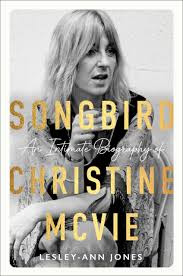
Songbird: An Intimate Biography of Christine McVie Lesley-Ann Jones

I'll start right off with the conclusion of this review: don't bother.

Supposedly the author was a friend of Christine McVie. Clearly McVie was a very private person, and if Jones was her friend, she certainly was not an intimate one, regardless of the book's title. Just how revealing was a guarded rock star with a rock journalist "friend"? I would speculate that the answer is "not so much".

And so speculation is what Jones does repeatedly in an attempt to explain McVie's childhood, her relationships with her parents, where her talents came from, and her motivations for many decisions throughout her life. She talks in depth about McVie's phycological background and reasons for her life's pathway with a psychologist that never met Christine McVie. She uses a jealous bass player that wanted but never got John McVie's role in Fleetwood Mac like he is an expert on Christine. 

No family members contributed. No Fleetwood Mac members gave new insights (although they are often quoted from past interviews). No lifelong close friends (real ones) talked to Jones. No neighbors from  Wickhambreaux, the small country town where Christine lived for some fifteen years had anything to say.

There's scant detailed or new information on the Fleetwood Mac records to which Christine famously contributed. In fact, I thought Jones wasn't even going mention Heroes Are Hard To Find, when she went off on a multi-page tangent and discussion of Bob Welsh's departure from the band before she even mentioned Heroes, the last Fleetwood Mac album on which he was featured. She of course spends lots of pages on the famous version of the band, but skims over the 1970-1974 era, when Christine wrote many of the bands best songs during the transitional phase, and helped keep things together before Buckingham and Nicks signed on.

The book covers all the sex, drugs and rock and roll mess and excess that was the famous post 1974 band. There's nothing new here, that story has been told to death. Same with her disastrous love of Dennis Wilson, a brief period of true love for Christine that ended in heartbreak.

If Lesley-Ann Jones was actually a friend of Christine McVie, she would have never written this sham of a biography.

Tuesday, November 28, 2023

Ted Gioia Music: A Subversive History 2019

Ted Gioia has written extensively on music and is clearly well versed in delivering a theory and supporting it with extensive research. 

This is an interesting take on music history that postulates music as a subversive element, challenging the status quo and involving violence and societal change, and not just recently, but from the beginning of civilization. Once the upheaval is over, these new musical trends become subsumed and made profitable by mainstream society. Furthermore, musical change/new musical expression/progress comes exclusively from those marginalized on the fringes of society. 

That's a pretty big theory, and Mr. Gioia backs it up with a ton of research. Clearly an academician, his writing occasionally shifts from engaging to pedantic, but not too often. Most of the time the book is quite readable, and the historical episodes he uses to support his theories are interesting in and of themselves.

Like most academic research, data that doesn't support the hypothesis is mostly ignored, or explained away as somehow actually in line with the premise. Still, the book does a good job of digging deep into the subject and Gioia is a skilled writer and explainer of things. 

It is not a holistic history of music, so you should not expect that. It is an alternative to the musical history told by those who have subsumed and monetized radical musical elements into the mainstream. As such it is a fascinating read, and quite unlike anything else on the topic. 

Mr. Gioia has written quite a few interesting sounding books about music. If those other books are as good as this one, you might be reading his work for a while.

Thursday, July 4, 2019

David Byrne How Music Works 2017


David Byrne is an interesting guy, and multitalented. As the leader of the Talking Heads, he always seemed a bit quirky in a smart, sophisticated, ironic sort of way. This book, essentially a collection of essays on his own career in music as well as music itself, is an excellent read. Part autobiography, part treatise on music in relation to performance spaces, technology, neuroscience, and society, the book is readable, insightful and well researched. This 2017 edition adds one chapter not included in the original 2012 printing.

Chapters investigate musical styles and the effects on music of the environments in which the performances take place (Chapter 1), how we choose what we listen to (Chapter 5), and how to sell music in today’s environment as well as how things used to work (Chapter 8). Other essays explore how new music can be encouraged by the “scene” that encourages performers (Chapter 9, mostly a explanation of why CGBG became a famous hole in the wall), a great treatise on financial support for the musical arts, music therapy and the social fabric of our relationship with music (Chapter 10), and a summary that touches on our personal experience of music, looking at neuroscience and social factors (Chapter 11).

The more autobiographical sections focus on Byrne’s performance (Chapter 2), his recordings, including several interesting insights into how recordings have changed (Chapter 6), and his collaborations with a wide variety of musicians from different genres since his days with Talking Heads (Chapter 7).

Two chapters (3 and 4) explore how Technology Shapes Music, and it’s a concise history of analog and digital technology’s effect on music and performance since the beginning of recorded music in the early 20th century. It is a nice overview, intriguing and a bit controversial at times. Byrne makes some excuses for digital sound quality, but overall he handles the progression through the last century and a quarter with aplomb.  This section applies his research to both how we listen to music as well as how it is recorded and played back, and how these technologies interact with performance.

There is none of the dirt dishing about band members that fill many rocker’s autobiographies, and there is no real attempt at explanation of why he’s such a brilliant guy. And those, along with many other qualities, make this a book that probably shouldn’t be considered an autobiography at all.

It’s brilliant, it’s engaging, it’s original and fun to read. And you'll probably learn something, too.

Tuesday, March 28, 2017

Anatomy Of A Song Marc Myers 2016

Mr. Myers book is a lot of fun. The audience that agrees with me might be a fairly narrowly defined sort.

This is a story about singles in a time when the 45 was changing from the driving force behind popular music to a sales device for LPs. And that story is told pretty well by the author's own narrative. He has to stretch his point beyond reason a few times, but not many, and the stories behind some of these performances are excellent. Not in any tell-all sort of way, but with fondness and nostalgia.

The author interviewed artists, producers, musicians and songwriters about the recording and producing of these classic singles. It is an easy read and highly enjoyable. Well-edited for the most part, which keeps it from being indulgent. The interviewees often have fresh perspectives that go beyond the technical to the sublime.

All of these songs come from 1952-1991. But the core of the book features the 1960s and 1970s when the record industry was changing in a significant way, and the relative importance of singles was still high. From a historical perspective it is an excellent book, with good observations to add to the already thick body of work surrounding the subject.

From the perspective of a music lover that first heard most of these songs on the radio, it is a lovely ride back through a fabulous time in pop music history.

In that the 60s and 70s are heavily featured, it may be of most interest to boomers.

Really a fun read. The author's approach is engaging, and the stories are delightful.

Monday, September 10, 2012

Tom Moon 1001 Recordings to Hear Before You Die 2008

I recently finished reading this delightful book. Tom Moon is a Philadelphia-based writer that has written for GQ, Rolling Stone, Spin, Vibe, Esquire, Harp, and Musician, and has been featured as music reviewer on National Public Radio. He is clearly knowledgeable about music, and is equally comfortable with classical, jazz, world, punk, pop and hip-hop. And he seems to honestly enjoy it all.

He sometimes sticks to the recordings that make everyone's lists. At other times, he chooses the record that most critics would call the second best, just to stay away from the most obvious choice- and he comes up with a valid defense of his opinion when he does this. More importantly, for someone who might use this book to expand both their horizons and their collections, these slightly different recommendations are particularly insightful.

Each recording gets a brief review/introduction with reasons why you need to hear it. Sometimes it goes beyond how great the music is to how important the music is to the development of a genre. Each selection also includes additional recommended recordings by the same artist, as well as by other artists mining the same vein, or some similar offshoot. Some of these are quite illuminating.

The best reason to be attracted to this book is if you are interested in getting introduced to new musical styles and genres. Moon spreads the titles around pretty equally, so if you're a rocker that wants to discover the blues, country, or R&B roots of that genre, there's plenty here to get you beyond started. Want to hear some of the most renowned classical and jazz recordings? Again, Moon can take care of you. Same thing for hip-hop, R&B and soul. And if you think you're ready to explore "world" music - that mix of international styles that have little in common (unless they are both Portuguese) other than they sound dramatically different from most Western styles- this is an excellent resource.

It is easy to nitpick Moon's selections, but we are talking about taste. If all music critics agreed with each other, we'd only need one of them. I was duly impressed with the depth of his knowledge, especially outside the mainstream, which is already well covered by the gazillion Top 100 whatever lists that have been published. Everything from Fela Kuti to Slayer, from Zappa to Mozart, from Big Bill Broonzy to 10cc, from Sex Pistols to Phillip Glass. And in between.

If you're a collector, don't read this book until you pay down the Visa bill.

Sunday, October 11, 2009

Greg Milner Perfecting Sound Forever 2009


I just finished reading Greg Milner's excellent book, the title of which is a play on the classic CD sales pitch from the 80s, "Perfect Sound Forever". Mr. Milner traces the history of recorded sound from Edison's wax cylinder to today's ProTools computer-based recording, and manages to show the arc of history by telling many interesting stories of the technologies and personalities involved in the progress through the twentieth century to today. 

If you thought that format wars started with VHS or BETA, or SACD or DVD-A, Milner tells us of the format war of the 1920s between Edison's Diamond Disc and the Victor company's Victrola. And it was Edison's relentless pursuit of acoustic recordings, which he knew sounded better than the electronic recordings (even though they did not play as loud) that helped him lose that particular round. 

Milner tells the fascinating stories of the early "Tone Tests" designed to prove the quality of the new recorded media. These sales demonstrations had opera singers sing live, followed by recorded versions to wow audiences with the fidelity of the recordings. The focus, even early, on fidelity and sound quality is particularly telling in light of the changes that have reduced fidelity of recorded music in recent decades. And Milner has plenty to say on that topic as well. 

Along the way the author interviews recording engineers, producers, businessmen, composers, and audiophiles, weaving wonderful stories that build into a comprehensive history of recorded music that focuses primarily on the recording process. The attitudes towards sound recording and the enjoyment of those recordings in the home over the past sixty years is a tale that raises questions about how we listen and why we like, or don't like, what we hear. Milner covers this era with a mix of the reporter's objectivity and the great storyteller's colorful insights. The advent of sampling synthesizers in the 1980s heralds the coming move away from analog recording studios, and the push towards digital, and then to the now pervasive ProTools, and the questionable benefits this progress has brought. The process of mixing pop music to sound louder than other CDs to the point of dynamic compression is given considerable discussion, as is the controversial use of the Auto Tune Pro Tools application. There isn't much said about the SACD and DVD-A formats, and that seems a little odd, given how comprehensive the book seems otherwise. Then again, what can be the point of spending time on another marketing debacle. 

It is a very fun read while being very informative. That's a good book any day. My only warning is that Greg Milner is pretty clearly in the analog camp, even though he tries hard to at least sound objective. If you think anybody that listens to vinyl is completely nuts, this might not be your book. Then again, if you want to know how we got to this place in recorded music, and be entertained while you learn, read this book. Highly recommended.