Friday, March 21, 2025

Tracy Nelson Life Don't Miss Nobody 2023

A mere sixty years after her first record, Tracey Nelson graces us with yet another fine piece of work. That 1964 debut, Deep Are The Roots, was a sparse acoustic record of blues chestnuts with vocals, guitar, harmonica and occasional piano. It was fairly ordinary for that sort of thing, but Tracey’s vocals impressed the few that heard it. Next up was the first Mother Earth record in 1968 after Tracey moved to San Francisco and founded the band. Since then she’s recorded some 20 records for at least half that many different labels. A journey woman for sure, and even if she’s not a household name, any and all of her work is well worth hearing.

It had been ten years since her last record, and fans had reason to wonder if she was done. Not nearly. She produced this new one, curated a great set of songs and wrote a couple herself, put together a killer band, and invited several big names and friends to guest star. At seventy-nine, she hasn’t lost any of the vocal strength and interpretive skill she’s famous for, and dare I say, this may well be her finest work. 

A blues singer mainly, she has recorded country, rock, R&B, gospel and soul throughout her career. Her taste in material to cover is impeccable. She's written a bunch of good ones herself, most notably her signature tune Down So Low, which has been covered by Linda Rondstadt, Etta James, Dee Dee Warwick, Ellen McIlwaine, Maria Muldaur, and Cyndi Lauper.

Strange Things Happen Every Day kicks things off rocking a blues/R&B groove, with a great piano break. Kevin McKendree tickles the ivories throughout the record, and he's consistently fabulous. Doc Pompus' There Is Always One More Time features Mickey Raphael's harmonica and a big choir on the gospel choruses. The title track, co-written by Nelson with Mike Dysinger has a latin rhythm and hot horns. Your Funeral and My Trial from Sonny Boy Williamson's pen is a walking blues with more great piano. Ma Rainey's Yonder Comes The Blues is an old-timey blues with wonderful, and apropos clarinet. Marcia Ball and Irma Thomas join Nelson for the rocking Allen Toussaint swamp rock of I Did My Part. The gospel influences return for  a stunning Hard Times, featuring piano, accordion and the big choir again. Wow.

Willie Nelson guests on Hank Williams' Honky Tonkin', with steel guitar and more fine harmonica. Charlie Musselwhite, who was featured on that 1964 debut, plays knock-out harmonica on It Don't Make Sense, a Willie Dixon blues that also has a hot guitar break. Eugene McDaniels' Compared To What features Terry Hanck on sax playing off the piano in a tight dual solo section. Nelson co-wrote Where Do You Go When You Can't Go Home with Marcia Ball, and the gospel choir again rocks the choruses. A nice rocking version of Chuck Berry's Brown-Eyed Handsome Man features a bevy of female guests vocalists and rocks like crazy. The record ends with another version of Hard Times, this time with just Tracey and guitar to wind things down with deep emotion, in the simple acoustic style of her 1964 debut, bringing things full circle.

There isn't a weak song. The record was nominated for a 2024 Best Traditional Blues Record Grammy. Tracey sings everything with the powerful voice that is her trademark. If you're a blues fan or a Tracey Nelson fan, or heck, just a good music fan, you gotta hear it.
Saturday, March 15, 2025

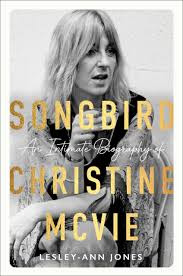
Songbird: An Intimate Biography of Christine McVie Lesley-Ann Jones

I'll start right off with the conclusion of this review: don't bother.

Supposedly the author was a friend of Christine McVie. Clearly McVie was a very private person, and if Jones was her friend, she certainly was not an intimate one, regardless of the book's title. Just how revealing was a guarded rock star with a rock journalist "friend"? I would speculate that the answer is "not so much".

And so speculation is what Jones does repeatedly in an attempt to explain McVie's childhood, her relationships with her parents, where her talents came from, and her motivations for many decisions throughout her life. She talks in depth about McVie's phycological background and reasons for her life's pathway with a psychologist that never met Christine McVie. She uses a jealous bass player that wanted but never got John McVie's role in Fleetwood Mac like he is an expert on Christine. 

No family members contributed. No Fleetwood Mac members gave new insights (although they are often quoted from past interviews). No lifelong close friends (real ones) talked to Jones. No neighbors from  Wickhambreaux, the small country town where Christine lived for some fifteen years had anything to say.

There's scant detailed or new information on the Fleetwood Mac records to which Christine famously contributed. In fact, I thought Jones wasn't even going mention Heroes Are Hard To Find, when she went off on a multi-page tangent and discussion of Bob Welsh's departure from the band before she even mentioned Heroes, the last Fleetwood Mac album on which he was featured. She of course spends lots of pages on the famous version of the band, but skims over the 1970-1974 era, when Christine wrote many of the bands best songs during the transitional phase, and helped keep things together before Buckingham and Nicks signed on.

The book covers all the sex, drugs and rock and roll mess and excess that was the famous post 1974 band. There's nothing new here, that story has been told to death. Same with her disastrous love of Dennis Wilson, a brief period of true love for Christine that ended in heartbreak.

If Lesley-Ann Jones was actually a friend of Christine McVie, she would have never written this sham of a biography.

Friday, March 7, 2025

Donald Fagan, Michael McDonald, Boz Scaggs The New York Rock and Soul Review: Live at the Beacon 1991, The Dukes of September Live at Lincoln Center 2014

Not every release you might enjoy needs to be important. Sometimes just "fun", or "nice" or "cool" is all that's needed. That's how I feel about these releases. Neither of them is a good as a good Steely Dan, Boz Scaggs, or Michael McDonald record (Well, maybe not McDonald). But they are well worth your time to hear them.

Both feature the three stars. The New York Rock and Soul Review features additional guest stars worthy of their appearance. And both are backed up by stellar backing musicians and vocalists.

The New York Rock and Soul Review: Live at the Beacon includes Phoebe Snow, Charles Brown, and David and Eddie Brigati, covering Rascals hits, soul gems, Brown's blues, Steely Dan and Doobie Brothers hits. We get hot guitar from Jimmy Vivino and others, and great horns from Cornelius Bumpus and a great horn section. What's not to like?

Twenty years later the three got together and toured. The band included Steely Dan regulars plus all-pro horns and backup singers. Without the guests, we get that much more of Steely Dan and McDonald/Doobies, and considerably more Boz Scaggs, which can only be good. A few choice soul covers round out the set, with the Isley's Who's That Lady? being a standout.

You don't need these records, but you'll probably enjoy your time spent with them.

Friday, February 28, 2025

Dwight Yoakam Brighter Days 2024

In 1993, Dwight Yoakam made one of the best records ever, This Time. And not just country records, but best records ever, period. Every song, every note, every lyric, just about pure perfection. I followed his work for a while after that one, and I liked Gone 1995, and A Long Way Hone 1997. I even liked his covers record, Under The Covers 1997.

The ones before 1993 were all solid, and many critics and fans rave about the first three, and well, I liked those too. In this century he has made plenty of competent records, all with some great songs, but none quite reaching the perfection of his work in the mid-nineties. But they come mighty close, and he's made more solid records than most artists in any genre. His Bakersfield-inspired country/rock and his authentic vocal twang have stood the test of time, and his songwriting is impressive and mostly consistent.

Now, after an eight year hiatus comes Brighter Days, and if I may say so, it lives up to the name. The record storms out of the gate with Wide Open Heart. The lead single I'll Pay The Price is a Bakersfield beauty filled with melancholic hope. Other highlights include the sad California Sky, stomping Can't Be Wrong, hokey I Spell Love, the optimistic title track, a cover of the Byrd's Time Between (he has a knack for finding great songs to cover), a rocking version of Keep On The Sunny Side, and the "save the last dance for me" sentiment of Every Night, which rocks the record to a close. There aren't really any weak songs. With fourteen tracks, you'd almost expect some filler, but instead the songs just display all the various aspects of his talent. 

He never really went away, but he's back. 

Monday, February 24, 2025

Eva Cassidy I Can Only Be Me 2023, Walkin' After Midnight 2024

I wrote about Eva Cassidy before, covering her Live At Blues Alley and the 2015 expansion of that record, Nightbird. In the Blues Alley review, I also discussed the many posthumous records released after her untimely death, all of which contain moments of beauty, and none of which would have seen the light of day had she lived (except for Eva By Heart, which was almost complete before her demise). While she has her fans in America, she is rabidly adored in the UK and parts of Northern Europe, where she has had far more sales success than in the US. Oddly, her posthumous records have sold better than her finest hour, the original Live At Blues Alley.

I Can Only Be Me is previously recorded vocals (isolated with AI technology) with The London Symphony Orchestra providing the orchestral backgrounds. It is pretty, and the orchestrations are lush and complement her singing quite well. But all of the vocals heard here are previously released, and her voice is the show. While orchestrated versions may well appeal to some of her fans, there's really nothing new here. 


Walkin' After Midnight is actually material that has not been previously released. It was recorded thirty years ago at the Maryland Inn’s King of France Tavern in Annapolis. Without her usual full band, only bassist Chris Biondo and guitarist Kieth Grimes, along with guest violinist Bruno Nasta accompany Ms. Cassidy and her acoustic guitar. Most of the songs were also performed just two months later for the Live At Blues Alley session, but these casual arrangements are unique to her body of work. Her cover of ZZ Hill’s Down Home Blues is a song not previously released by Cassidy, as is her version of Desperado, which is a live recorded vocal isolated from a different performance with a new piano and organ backing provided by former bandmate Lenny Williams. The stripped down band lets Cassidy's vocals shine, and the addition of violin makes for a different twist on some of the songs. Cassidy is in particularly fine voice and the recording is very good. Cassidy herself didn't want to release Blues Alley because she had a cold the night it was recorded (you can't tell), but she's certainly healthy here. Compared to most of her tossed-together posthumous records, at least this one is from one show (almost), and it is a worthy addition to her catalog.

While I have not always been happy about the way her legacy has been milked by her family, I absolutely recognize her as an amazing talent, an astounding voice coupled with heartfelt interpretations, and an impeccable taste in songs to cover from a broad spectrum of genres. Live At Blues Alley remains an essential addition to any collection, and either or both of these will find an audience among her fans.

Saturday, February 15, 2025

Overlooked Gems

Katie Love's Ready Or Not from 2015 is a pure pop/soul gem. According to her Facebook page, it was pressed on vinyl. It's really fine, along the lines of a Canadian Duffy, with less bombast. Every song is a winner. There were some country singles that predate this record by Katie Love Hess that I think are the same person. 

Another lesser-known but solid record is Boomtown (1986) from David + David, who were David Baerwald and David Rickets. The record is full of well-crafted classic rock ala Springsteen, examining hard times, isolation and urban decay. The record reached 39 on the Billboard charts. Both Davids later contributed to Cheryl Crow's Tuesday Night Music Club (1993), with Baerwald one of the primary guitarists.
Splinter were a power pop duo who's debut, The Place I Love (1974) was the first release from George Harrison's dark Horse Records. Harrison produced, played guitar, and brought in an all-star supporting cast to make a lovely Badfinger-like beauty.  They went on to record at least four more records, and two of them are available for streaming in addition to this knockout.
April Smith and the Great Picture Show released Songs For A Sinking Ship in 2010. Highlights include Colors, Terrible Things, and Can't Say No, but the whole record is big fun. Several songs were used on TV shows. Colors was used in a memorable commercial for Valspar paint. Smith has a big brassy voice, the band is talented, and they put on a great show, which I was fortunate enough to see. Sort of old-timey, vaudevillian window dressing on some quality pop songs.
Christian Cuff's Chalkboard (2010) is just one of the best folk/rock singer-songwriter records you haven't heard. His first record was a simple guitar and voice affair, but they went all out for the follow-up (both are available streaming). Keyboards, bass, guitar, drums, harmonica, woodwinds, trumpet, baritone horn, and string quartet are all used generously to broaden the palette and make this record special. The arrangements are top notch. Not to be missed. 

Any one of these will make you happy to find a lost gem. Five very different records, you're almost bound to love at least one of them.

Saturday, February 8, 2025

Louis Cole nothing 2024

In my Best of 2024 post, I described this record as "Jazz fusion/pop/funk/electronic/orchestral music" and believe it or not, that is accurate.

Cole made this record over a period of three years, mostly recording live with the Metropole Orkest conducted by Jules Buckley during three or more live performances in 2022 and 2023. The orchestra was also recorded in a studio session in 2021, and there are several vocal and instrumental overdubs, but it's mostly live. In addition to the orchestra, there's Cole's remarkable drumming, synth and vocals and a small rock band of bass, guitar, keyboards, and saxophone, plus six vocalists in chorus (including Cole's longtime musical partner Genevieve Artardi).  The record took six months for Cole to mix, combining different takes and merging multiple orchestra recordings in to a whole. There's a lot going on.

The record opens with Ludovici Cole Est Frigus, a lovely modern classical overture. Things Will Fall Apart follows, and it is a funky rock tune with Cole's falsetto vocals and hot drums, and orchestral backing. I should note here that all but two of the songs feature the orchestra either prominently or in the  background, and those two are short Cole solo pieces. So if I don't mention the orchestra, they are always there. Life is next, and it's a fast pop song with vocals and crazy hot playing. It Always Passes is a slow, charming orchestral piece.

Cruisin' For P, a highlight, is a big band jazz that swings, featuring just the brass and woodwinds of the orchestra. It has a swell piano solo and Cole's outstanding drumming, always fast and busy. The rock of A Pill In The Sea shows off the band, the vocal chorus in a quieter middle section, and then returns to rockingly with a wild synth break. nothing, the title track, is an airy, ethereal orchestral piece that is lovely. Who Cares 1 is all Cole on multiple instruments, a pulsating alt-rock gem. Who Cares 2 is sort of the same song, but with Cole's drums and voice, the vocal chorus, and a big dramatic orchestra section. It sounds like an odd mix, but it works. I could say that about the entire record.

And that's just the half of it. Wizard Funk opens side three, and it's another brass and woodwinds only funky big band jazz that has a lilting, almost calliope-like sound in parts. Weird Moments is aptly titled, with fast drums, choral voices, and horn blasts, all amidst experimental orchestral funk. Soft vocal and orchestra fill High Five, while a sweet melody and and fine synth break highlight These Dreams Are Killing Me. On Shallow Laughter: Bitches, lilting strings and vocal are followed by funky drums and a wild dual sax and synth break.

Let It Happen is an ethereal, chant-like, drums, vocal and orchestra piece. The 11 minute Doesn't Matter is modern orchestral melodic melancholy that builds slowly with simple, fetching melodies.  Finally, the gentle solo piano of You Belong puts a tender coda on the whole affair. Then you can sit and ponder what you just heard.

It works as a singular piece of modern stylistic potpourri for those who still have the attention span to listen to music for an hour straight. If the description above has put you off this music, I have performed a disservice. Cole's writing for orchestra is melodic and easy to digest. This isn't atonal, challenging orchestral music, even if it is modern. His funk/pop/rock is fast and fun. It really is a unique, enjoyable musical experience, and that is pretty darn rare these days. It deserves to be heard, and if you have any kind of open mind, you'll be glad you gave it a try.