Saturday, July 11, 2020

Norah Jones Pick Me Up Off The Floor 2020


Norah Jones is a beguiling artist at her best. A lovely singer, a talented piano and guitar player, and a skilled songwriter, she has crafted some of the best jazz, jazz-pop and pop of the last twenty years. But not everything is equal to her best work, and her records have vacillated from greatness to downright disappointing. Her best records, like the debut Come Away With Me, have been followed by lesser product. Both Feels Like Home and Not Too Late, while certainly not bad records, couldn't touch the debut. Then The Fall was a revelation, with her moving to guitar on some songs and with a production that took some of the sleepy out of her songs. That was followed by the mismatch with Danger Mouse on Little Broken Hearts, which showed that there was a way to make a less than great Norah Jones record without making it boring. Then 2016's "return" to jazz, Day Breaks, was a monumental work, proving she had the goods still, and that maybe the pool of her talents was deeper than we knew. Last year's Begin Again was a collection of writing collaborations that sounded less cohesive than her better efforts. Which brings us to Pick Me Up Off The Floor.

Jones has always specialized in soft, gentle compositions. Some of her work is a bit too sleepy sometimes, but there are generally a few songs that pick things up a bit. Not so much this time around. This one starts off slow, never speeds up, and then peters out all together. Not that tempos ruin the record, but don't come looking for much in the energy category.

How I Weep, softly, minimally played on piano and strings, sets the tone. Flame Twin has a nice organ part and interesting lyric. Background singers and Pete Remm's Hammond B3 keep Hurts To Be Alone interesting. Heartbroken, Day After is a slow sad breakup song. It is a good one, but four songs in and barely a rhythm in sight. Say No More has a nice rhythm and some melody, and you might think it's the beginning of getting this work moving. But not so much really. The chorus of Norah's vocals shines on This Life, with its appropriate lyric for the pandemic we are living through.

Side Two has to pick things up, right? To Live is a beautiful song, urging the singer to live in the now, again with lovely harmonies she sings herself. A collaboration with Jeff Tweedy, I'm Alive, is next, and it is good. The lyrics seem to focus on pandemic-me too-politics, and the tempo is at least moving forward. Tweedy's guitars are a nice change of pace. Then it's over. Were You Watching? (a too long, too sad dirge), Stumble On My Way (just slow), and Heaven Above (beautiful, and oh yeah, slow) try to out-slow each other, and they all win.

I guess I shouldn't be surprised. Jones' work has never been exactly upbeat, but this is just too far down the lack of tempo road. It is a beautiful record, full of sad, melancholy songs perhaps best described as art songs. It is well-written and performed. The musicians (usually just piano, bass and drums with one or two helpers along for the ride) do a fine job. As theme music for our current state of pandemic depression, it might be perfect. 

Maybe I'm being too critical. Several of these songs are strikingly beautiful. Jones' voice is lovely. Lyrics are mostly strong. There isn't a note out of place. Shouldn't that be enough?

Friday, June 26, 2020

The Rubinoos 1970 - 2019

There is a new Rubinoos LP out, From Home 2019. Produced by Chuck Prophet, with new songs by Tommy Dunbar and Prophet, it is chock full of classic Rubinoos delights. The straight-ahead power-pop Rubinoos sound, like the Archies or The 1910 Fruitgum Company, delivered without a trace of irony. Prophet wisely leaves their sound alone, letting all we love about the Rubinoos come shining through. The nostalgia of Do You Remember, the mid-tempo magic of January, the pristine vocals and syncopation of Do I Love You?, and the ancient Greek goddess Phaedra done up all Beach Boys/Raspberries style. Honey From The Honeycombs idolizes the great female drummer. Masochist Davey takes a different look at not-quite-sweet love. The record closes with Watching The Sun Go Down, a lovely ballad that Jon Rubin sings beautifully, and the band adds great harmony. It is another fine outing from this band that has been doing this sweetly perfect pop for fifty years.
Although the band formed as early as 1970, their recorded debut was on the Beserkly Chartbusters compilation in 1975. They performed a cover of Gorilla by the DeFranco Family. Then, in 1977, came their debut, The Rubinoos. A more perfect pop record is hard to imagine. While the cover of I Think We're Alone Now was a modest hit as a single, the record is rife with gems. Leave My Heart Alone, Rock And Roll Is Dead, Nothing A Little Love Won't Cure, Make It Easy, and I Never Thought It Would Happen are all chart-worthy. Catchy melodies, great hook-filled choruses, remarkable harmonies, and the crystal clear pipes of Jon Rubin, along with fine ensemble playing and singing throughout, it would almost be legacy enough. 
If it is hard to imagine a better record than the debut, Back To The Drawing Board 1979 comes mighty close. More great songs from Tommy Dunbar, and more of everything on offer on the debut. Fallin' In Love, I Wanna Be Your Boyfriend, Drivin' Music, Operator, Arcade Queen, Lightning Love Affair, and 1, 2, 3 Forever maintain the quality, and a tour opening for Elvis Costello should have made them famous. But Beserkley Records was never able to support them as well as a larger label, and let's face it, although this music is charmingly perfect, in the late 1970s, it is decidedly not contemporary. It is an interesting exercise to contemplate what might have been if this music had been released in the mid-sixties. Because it is certainly of that time, but also better than most of the competition even then.
Party Of Two 1983, produced by Todd Rundgren with instrumental support from Utopia, yielded If I Had You Back, the video for which got some MTV air time. It was a decent EP, but didn't capture their sound (or their best songs) as well as the first two. Around the same time they recorded the theme song for The Revenge Of The Nerds movie. And that would have seemed to be the end of the Rubinoos.
They recorded another record in the mid 80s that never got released at the time, but in 1993 and 1994 those recordings were released as The Basement Tapes and Garage Sale. Rather than sound like demos, the material on Basement Tapes just sounded like the next Rubinoos release. The interest in those recordings confirmed that the band still had fans, and successful tours in Japan and Europe led to new recordings in the new century.
Paleophonic 2000 picked up where they had left off, and had a fuller sound, with great production from Kevin Gilbert. Amnesia, Early Winter, Pursuit Of Happiness, and the Raspberries' Beach Boys tribute Cruisin' Music jump with pop thrills and harmonies galore. Perfect Stranger is a glorious ballad, and a surf instrumental version of the Star Trek theme complete the mix.
2003's Crimes Against Music is their covers record. It is a wild mix of songs and styles, and it all comes out Rubinoos. Pop greats by The America Breed (Bend Me, Shape Me), Looking Glass (Brandy), Lou Christie (If Only My Car Could Talk), and the Beach Boys (Heroes And Villains) are mixed with less likely choices like Eurythmics, Todd Rundgren, Elvis Costello, and Yardbirds. It works really well, but it is a covers record, and that means that we miss out on Tommy Dunbar's unique songcraft. The thing that is so consistently fun about Rubinoos is their original songs that sound like you heard them 30 years ago but can't remember where.
Twist Pop Sin 2005 continued their more recent successes. You Hit The Nerve is classic Rubinoos pop, and there's plenty to go around with The Other Side Of The Rain, In The Worst Way, She Won't Let Me, Nobody Said Life Was Fair, and the sweet ballad Someday. Maybe not their strongest effort, but not a disappointment by any measure.
2010 saw Biff-Boff-Boing. A children's record, I haven't heard it. I listened to the samples, and there is no reason not to like their sound as a vehicle to entertain children. Their sound has always been for kids. In 2011, no one expected Automatic Toaster. Released to coincide with a European tour, the record appeared on the scene without fanfare. And it is a pretty darn good Rubinoos record. Great songs keep coming with Two Guitars, Bass And Drums, I Pity The Fool, Mak Schau, Black Is Black (Los Bravos cover), and Past, Present And Future.
They just won't go away. And we are all the better for it. 2015 saw 45. As in 45 rpm of course, but also marking 45 years since the band formed in 1970. And guess what? It is their best effort since the first two, hands down. Donn Spindt is back on drums (missing since Paleophonic), and Dunbar managed to write his best set of songs in a long while. Run Mascara Run, Graveyard Shift, I Love Louie Louie, Countdown To Love, You Are Here, That Thing You Do, All It Takes, She Drives Me Crazy, and This Is Good all rock like crazy, and the ballad What More Could You Ask Of A Friend is as good a sweet ballad as they have ever done.

Who would have thought that the Rubinoos would still be with us in 2020? It is amazing really that they have managed to keep doing their uniquely Rubinoos thing all this time. You can't go wrong with the first two records. Get them on vinyl if you have that capability. None of their records suck. The new one, From Home is excellent, as is 45, and Paleophonic. Do you miss the Raspberries? Tommy James? Simple pop for grown-ups? Rubinoos are the answer to your dilemma.

Wednesday, June 10, 2020

Elephant's Memory 1972


Elephant's Memory are one of those many strange stories in rock history. A New York City band that featured horns, eclectic songwriting, multiple line-up changes, and several record labels, they are best known for being the backing band on Some Time In New York City by John Lennon, easily arguable as Lennon's worst release, although that isn't due to Elephant's Memory as the backing band. John and Yoko produced this 1971 Apple records outing, which has never been released on CD.

Side one opens with Liberation Special, a fast-driving, hard rocking song with a solid riff, vague lyrics about freedom, and good drive. Baddest Of The Mean follows, and it is a big plodding boogie with Stan Bronstein's gravely baritone delivery that verges on the Wolfman Jack sound, and not in a good way. The Johnny B Goode riff of Cryin' Blacksheep Blues follows, with similarly bad vocals, but a nice sax solo. Chuck 'N' Bo is a hard driving boogie that tells the story of John and Yoko attending a Chuck Berry and Bo Diddly concert.

Side two is a bit more varied. We get a few sung by members other than Bronstein, which helps, but the lyrical content is consistently weak, and they play off their celebrity producers again with the closing Local Plastic Ono Band. The country-ish Wind Ridge, the big loud Power Boogie (with more Wolfman vocals), and the hard rock of Madness and Gypsy Wolf keep things moving.

The band is tight. The lead guitar is generally interesting. The horn solos are highlights when they appear. The recording has a thick sound that could be tightened up a bit, but that doesn't wreck it.

I've said it before- All you really need is a singer, a songwriter, and a solid drummer. I can't say anything bad about the drumming. Songwriting is musically simple but effective, but lyrically banal. And vocals are a big problem for the band. They had other singers in their earlier iterations, but Bronstein just isn't up to the job, vacillating between his gravelly baritone and a high scream, it is a hard voice to see as an effective instrument. Maybe in a metal band, but not here.

Better lyrics and vocals would have made this a better record. But not better enough to make it great. There are millions of lesser artists that managed to put out a few records. Some of them made famous friends, but that doesn't mean they made memorable music.

Thursday, May 14, 2020

Great Sounding Recordings

I don't really think of myself as an audiophile, but by some definition I must be one. I think of myself these days as a guy that loves music and has a much better than average stereo system. But how I got that system was by being an audiophile. Maybe I should define what I mean by an audiophile. To me, an audiophile is someone who is expressly interested in the sound that an audio system produces, and who more than likely wants that system to achieve something important to them. Using that definition, I was an audiophile back some twenty years ago when I started to put the system together that I now own. The system I have now was assembled between 2002 and 2009 for the most part, with vinyl playback gear upgraded in 2015 (although what I had in 2009 played vinyl just fine, but not as just fine as now). You can check out the kit at this post and you can read all of my equipment-related posts by using the Stereo Equipment label.

When I went shopping for speakers, which I contend is the most important buying choice when it comes to your stereo system, I recorded (on my Marantz CD recorder- which I miss dearly, but it died) a disc of songs that I felt would help me evaluate speaker systems. Naturally, I choose material I was familiar with, but also material that I thought would help me evaluate a speaker system by challenging that system to make the songs sound great. An exceptional recording was usually involved, but not really all the time. Some of the material challenged systems to provide what the late great Art Dudley would call rhythm and pacing. This is a highly underrated quality, and it is nebulous to some degree, but there are systems that can make big loud beautiful sound and yet they do not swing or rock.

I recorded the Instrumental Introduction To Don't Look Down, a track from Lindsey Buckingham's Out Of The Cradle at eight different dB levels so that I could be assured of listening to the music at similar volumes. This is important, because louder music will inevitably sound more impressive than less loud presentations. These tracks allowed me to get the overall volume of the system similar from audition to audition of speakers. Other than that technical issue, the tracks on my original "Audition Disc" included the following, with the reason for their being included:

Boats To Build by Guy Clark from Boats To Build- beautiful acoustic guitar, open space in the presentation, excellent vocals with a chesty vocal presentation that some speakers will overemphasize.

Bridge Over Troubled Waters by Eva Cassidy from Live At Blues Alley - amazing female vocals, great bass with definition, very dynamic recording that goes from soft to quite forceful.

Rock My Soul by Elvin Bishop, recorded from Rock My Soul vinyl - this songs rocks and swings, and not every system can make it happen. There's great bass, and there's an organ trill late in the song that can reveal irritating treble in some systems.

The Song Remembers When by Trisha Yearwood from The Song Remembers When - more female vocals (audiophiles love female vocals), and again, a dynamic presentation that swells in the crescendos. Delicate instruments in the early part of the song, and emotional content that can be "too sterile" with some systems.

Everybody's Got Something To Hide Except For Me And My Monkey by the Beatles from The Beatles - I'm not sure if this was a great choice, but the cowbell and the drive of this song revealed some systems as too dry. If the system couldn't do rhythm, it showed on this track.

Song Of The Wind by Santana, recorded from Caravanserai vinyl - maybe the most important track on the disc. The searing guitar showed some speakers as strident, or harsh, in the treble. The percussion and organ trills in the early part of the track showed just how much inner detail could be revealed by a speaker system. And it rocks.

I Don't Want To Lose You Yet by Steve Earle from Transcendental Blues - not a great choice for the audition. Too much compression in the recording. Great song though.

I Got You (I Feel Good) by James Brown from Star Time - Rhythm and pacing. If you can't do this song, you got no soul, no swing.

Don't Look Down by Lindsey Buckingham from Out Of The Cradle - nicely recorded acoustic guitar, good overall sonics.

Corner Pocket and Lara's Theme from The Harry James Big Band King James Version direct-to-disc vinyl recording - hot, dynamic, horns in your face presentation. Any speaker worth owning should make this sound alive and super-hot. An amazing recording.

Hayden Quartet in G major, first movement, by The Emerson String Quartet from Hayden String Quartets - breathtaking quartet reveals any flaws with perfect acoustic instrumental recording.

Mozart Symphony No. 40 in G minor, fourth movement, by James Levine and the Chicago Symphony Orchestra (not sure of the source, maybe a Stereophile test CD?) - just a pristine classical recording, you should feel like your in the hall.

And that is the music I listened to when I decided to buy the Reference 3A MM deCapo-i speakers that I enjoy to this day.

I have amassed a long list since then of other worthy contenders that I might use to evaluate systems if I were back in the market. I listened to a revised Audition Disc when I visited Paragon back in 2014 and heard over $200,000 worth of stereo system.

Here's more exceptionally recorded music that will sound great on a good system and will test the abilities of any music reproduction. And they are also great performances.
Comes Love by The John Cocuzzi Quintet from Swingin' And Burnin'.
Paz by Tom Harrel from Wise Children.
Besame Mucho by The Frank And Joe Show featuring Jane Monheit from 331/3.
For Joy by The Sons Of Champlin from Hip Li'l Dreams.
First We Take Manhattan by Jennifer Warnes (with Stevie Ray Vaughn) from Famous Blue Raincoat - This may be the single best track to hear if you want to evaluate a system. Audiophiles have praised it forever, and for good reason. The rest of the first side is equally perfect, and Warnes' The Well from 2001 is also a magnificent recording. The Nightingale and the title track are perfect. You should get to know Jennifer Warnes' work if you haven't already.
Under The Boardwalk by Rickie Lee Jones from Girl At Her Volcano. I have the original 10-inch vinyl, and the dynamics and the vocals on this track are awe-inspiring.
Gloria's Step by Bill Evans from Sunday At The Village Vangard. The perfect piano trio.
Statesboro Blues by The Allman Brothers from At Fillmore East.
This Will Be Our Year by Bruce Robison and Kelly Willis from Our Year.
I wanted to include some of that "Eighties sheen", because some of it was good, but also, it presents a big sound from an in-your-face perspective.
Swallowed By The Cracks by David + David from Boomtown.
Every Time You Go Away by Paul Young from Secrets Of Association.

I rarely listen critically any more. I'd rather listen to music than pay attention to the recording or how well the system sounds. But I still catch myself when the music is so wonderfully recorded and presented.

Friday, April 10, 2020

Favorite Live Shows

I've seen plenty of great shows, and I am going to fail to remember them all here. But these have left a lasting enough impression that, well, I still remember. There are many that didn't make this list, and I want to give kudos to Sal over at Burning Wood for bringing the topic up. One of my friends is going to call me and say "What?! You didn't include ________!"  Trust me, I just can't remember them all. I saw NRBQ, but it was after Big Al left. I saw Van Morrison and the Kinks put on weak shows that I wanted so much to love. Todd Rundgren, Joe Jackson, Eric Clapton, Boz Scaggs (2 or 3 times), Trisha Yearwood, Robert Palmer, Dwight Yoakam, and many others, all entertained me. But when it comes to that mix of great performance, great vibe, and great timing, these might be my favorite shows:
The Band 1970 Cleveland Music Hall
I was 15 years old. I already loved The Band. My father drove my girlfriend and I to downtown Cleveland to see the show. They were between The Band and Stage Fright albums. They were incredible. No warm-up act. They came out and played two sets, about two hours total. The only time they said much other than "Thank You" at all was when Robbie introduced Lookout Cleveland and said he was thinking of us. I think he meant Cleveland, Tennessee all along, but that didn't matter.
Bruce Springsteen and the E Street Band 1973 John Carrol University Fieldhouse
The John Carrol Fieldhouse was a pretty big basketball arena by Jesuit college standards. Bruce was about to release The Wild, The Innocent, and the E Street Shuffle, and the band on the back of that record jacket was the band I saw. Vinnie Lopez might not have been what Bruce wanted, but this band kicked butt that night for sure. And Springsteen was the only guitar player, he was super-hot, and they played for three hours, and totally rocked the crap out of the place. They got tighter, and maybe more professional, as a band, but they never got wilder.
Sons of Champlin, The Tubes, 1975 Some small outdoor amphitheater, San Diego, CA
So back in 1969 my older brother sent me and my middle brother seven albums for Christmas. Go ahead, divide seven by two. And do it with adolescent males. Anyway, one of those records was the Sons of Champlin debut, Loosen Up Naturally. I've loved the Sons ever since. In 1975, after finishing school, I road-tripped to California and while visiting a high school buddy in San Diego, I visited a record store. I found the recently self-released Sons of Champlin album (on Gold Mine records, which would later be reissued by Areola) and when I bought the album, the guy behind the register said, "Hey, dude, are you going to see them tonight?" Right then I bought tickets even though the guy I was staying with had to work that night. He went to work. I went and saw the Sons. Champlin, Haggerty, and Palmer were all spectacular. I was surprised, but I liked the Tubes, too.

It really seems like there should be something else between 1975 and 1979. How odd.
Elvis Costello and the Attractions, The Rubinoos, 1979, The Agora Ballroom
Costello was doing This Year's Model and some of Armed Forces and the debut. Oh My God. 75 minutes of full steam ahead Costello and the Attractions. Not more than 30 seconds between songs, and no talk at all. The Rubinoos were playful and charming in the opening slot. They did I Think Were Alone Now and Sugar, Sugar.
Talking Heads 1983 Blossom Music Center
It was the big suit tour, which was made into the movie and album Stop Making Sense. It was very much worth seeing live. The concept was very cool, with David Byrne doing Psycho Killer solo with a beat box, then Tina Weymouth came on for Heaven, and it kept building until there were 10-12 people on stage. Burning down the house indeed.
Ahmad Jamal, 1990? The Purple Onion, Toronto
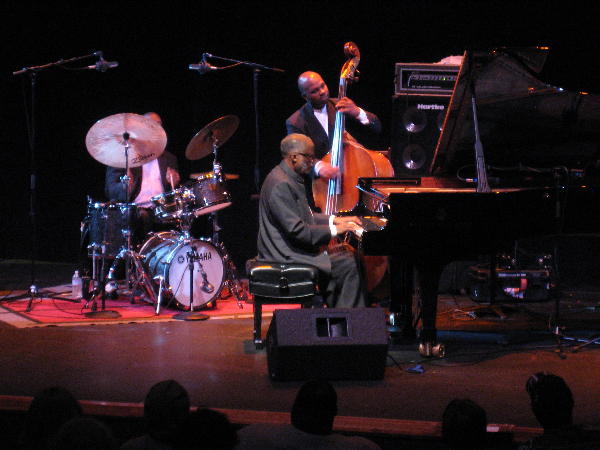
I went to Toronto to take my wife to see The Phantom of the Opera. The night before (or after?) we went to see Ahmad Jamal at the Purple Onion jazz club. I was mesmerized by Ahmad Jamal's trio. Such an amazing piano player. We sat at the bar about fifteen feet from Jamal, and we could see his hands on the keyboard. Breathtaking.
The Subdudes, 1986? Peabody's Down Under
If you ever have a chance to see the Subdudes, they put on a great show. Peabody's was relatively small, and they rocked it. Their soulful Louisiana funk was a unique. Tommy Malone was a triple-threat singer, songwriter and guitarist. Steve Amedée's tambourine replaced a drum kit way better than it should have.
The Neville Brothers, 1980s, Tipitina's, New Orleans
The Neville Brothers played Tipitina's most Fridays in the 80s, and were scheduled the Friday we arrived, but then the show was cancelled as they were opening for someone on tour. The vacation was already planned, so I went with disappointment in mind. Sitting in a bar I told the bartender the story, and he said that the tour show cancelled and they were playing that night. We went early and held our ground right in front of the stage for many hours through the Dirty Dozen Brass Band, until the Nevilles started about 11:30. They were still playing when we went outside for air at 3:30. It was a super hot night and a super hot show. 
Don Dixon and Marti Jones, 1986-88?, The Empire
The Empire was a less than great venue in Cleveland, but this was when they were trying pretty hard to break Marti Jones. The band included Jim Brock and Jaime Hoover, and they were so incredibly tight. One of my favorite live recordings of all time is Marti's Live From Spirit Square, and this show was all of that, albeit on an considerably earlier tour.
Lucinda Williams, 2001 The Odeon
There is no need to exclude sentimental favorites. My soon-to-be-wife and I saw Lucinda touring behind Essence. Lucinda and the band were smokin' hot. The definition of sultry. I'm sure there were people that went home talking about the way we danced.
Proclaimers, 2008 Beechland Ballroom
They had the full band with them, and they are just such great songwriters and singers and so much good fun. Rock that doesn't mind the pop. And delivered with verve. My friend Bob was aghast that not everyone was dancing! I've seen several other fine shows at the Beechland. It's a great room when the sound is right.

Sunday, March 29, 2020

Ahmad Jamal Ballades 2019

Ahmad Jamal will turn 90 this year, and his late career work has been consistently strong. 2007's It's Magic, 2011's Blue Moon, 2013's Saturday Morning, and 2016's Marseille are all fine outings. Playing in a quartet of piano, bass, drums and percussion, the extra percussionist seems to play perfectly with Jamal's innate sense of rhythm.

This time it is different. This time it is solo piano (with bass on three tracks). And from what I know and can research of Jamal's discography, this is a first. These ballades (a term used by Chopin to describe his short single movement piano pieces) are beautiful, and recorded beautifully. Pressed on heavy vinyl at 45 rpm, the sound is stunning.

The tracks were recorded in 2016 while Jamal was in France recording Marseille. There is actually a fourth version of the song Marseille on this set (there were three versions- two with vocals- on the Marseille release). There's a new solo version of the Jamal favorite Poinciana. There are only three Jamal originals in the ten song set (one is the composed-while-recorded Because I Love You), and lots of classics from Rogers and Hart, Cahn, and Mandel. All done in these pristine solo piano versions by the master of rhythm, subtlety, nuance and expression.

Jamal takes a melody apart like no one else. Sometimes he stretches things far from the root, while other times he plays so very close to the lyric. In fact, lyrical might be an excellent description of his playing. This is a really beautiful record, both a new expression and one consistent with Jamal's lovely body of work. Ahmad Jamal has been known to call jazz "American classical music". I don't know if it is classical, but it is classic all the way.

Wednesday, February 26, 2020

Dave Godin's Deep Soul Treasures Vol. 5

Dave Godin was a very interesting guy. Godin owned and operated a record shop in Great Britain that developed into a record label that licensed and released hundreds of obscure American soul songs that were unknown outside of southern America. He coined the term "Deep Soul" for these gritty, often gospel influenced soul classics. You know the stuff- great, deeply felt soul from below the Mason-Dixon line.

Godin was also a music journalist and spread his love of soul music through his writings.

And between 1997 and 2004, Ace Records in the UK released four stellar compilations curated by Godin and titled Dave Godin's Deep Soul Treasures from the Vault Volumes 1-4. I highly recommend them all, and covered them a long time ago in a post about soul box sets.

So now, some 15 years after Godin's too early demise, comes Volume 5. And of course the question is "Is it a worthy successor to the four volumes Dave curated?".

According to the liner notes, that are on par with the original series, quite a few of these chestnuts were chosen by Godin himself and Ace couldn't get licensing permission for them at the time of the original series. Others were known to be Godin favorites, and maybe a few are "inspired by" Godin's love of deep soul.

So the answer is yes. The soulful vocal and big organ of Ronnie Taylor's Without Love, the early Emotion's Somebody New, the pre-Motown Gladys Knight and the Pips Lovers Always Forgive, Judy White's Satisfaction Guaranteed, with hot guitar, horns and background vocals that all vie for best element, and Dee Dee Warwick's desperate vocal on Foolish Fool are all great moments in soul. Z. Z. Hill sings the crap out of Sam Cooke's Nothing Can Change The Love I Have For You, Kenny Carter's magnificent, pleading I'm Not The One is a scorcher, and Esther Phillip's take on Gil Scott Heron's Home Is Where The Hatred Is includes fine sax and horns on top of Phillips' capivating vocal.

And I could go on. There's 25 tracks, and there aren't any that bomb. If you like gritty soul (think Memphis or Muscle Shoals, and then go even deeper), this is an easy sell. Outsized soul, big, dramatic soul, and you've probably never heard a one. Deep Soul Treasures indeed.